 by
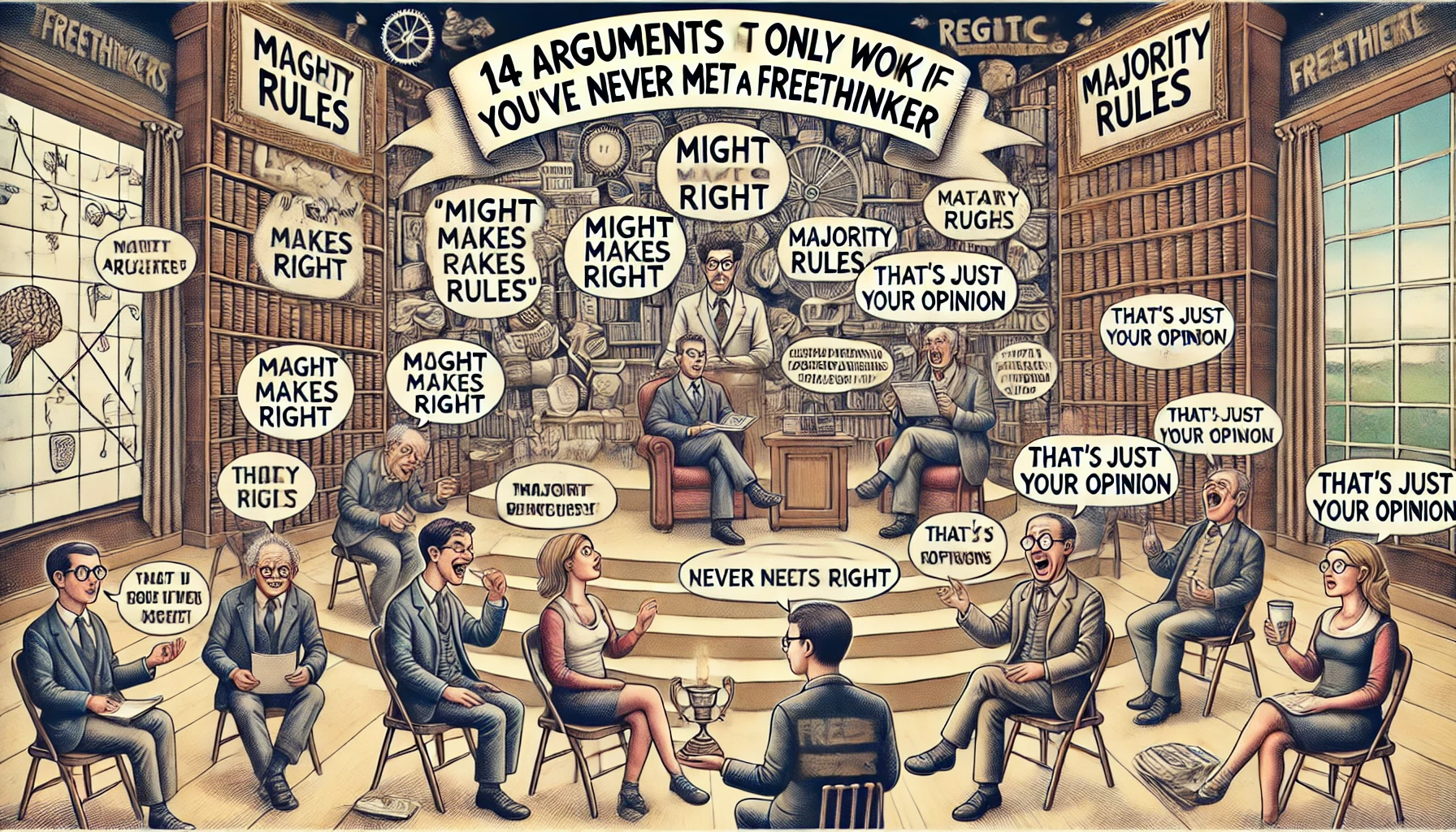
14 Arguments That Only Work If You’ve Never Met a Freethinker
Some arguments only fly in safe spaces—like Facebook comment sections, corporate PowerPoint presentations, or casual first dates with someone who says “I’m spiritual, not religious.” But freethinkers? They’re not safe. They’re the intellectual bouncers of reality, rejecting every lazy premise at the door and demanding receipts before letting your opinion in. If you’ve ever used these arguments in front of a freethinker, you probably still have emotional whiplash. Here are 14 arguments that disintegrate instantly in their presence.
“That’s just how I feel.”
Feelings are valid. Freethinkers know that. But if your entire position rests on “I feel like that’s true,” expect them to gently ask, “Have your feelings been peer-reviewed?” They’re not trying to gaslight you—they just don’t consider emotion a substitute for logic. Unless you’re explaining why you cried at the end of The Iron Giant, in which case they will nod respectfully.
“It worked for me.”
Cool anecdote, bro. Unfortunately, freethinkers are immune to the power of N=1 studies. Your cousin’s miracle diet, healing rock, or crypto scheme doesn’t count as evidence unless it’s repeatable and statistically sound. They’ll applaud your success—and then ask to see your methodology, your control group, and your receipts.
“Everyone’s saying it.”
This argument collapses under the weight of its own popularity. To freethinkers, “everyone” is not a source—it’s a symptom. The last time “everyone” agreed on something, it involved leeches, the Earth being flat, and boy bands with matching outfits. Expect them to ask, “Which everyone? And what’s their epistemological track record?”
“That’s what my pastor/teacher/CEO said.”
This isn’t just a logical fallacy—it’s a red carpet invitation to a freethinker’s TED Talk on the appeal to authority. They respect experts—but only when paired with scrutiny. Quoting your boss as gospel truth only tells them one thing: you’re loyal. Not necessarily right.
“That’s not what I heard.”
That’s great. What you heard might’ve been from your neighbor’s cousin who read a tweet from a guy who thinks Wi-Fi causes brain fog. Freethinkers don’t care what you heard. They want what you know, and how you know it. If you can’t provide a source, be prepared to be lovingly dismantled.
“That’s just your opinion.”
This phrase is often used like an ejector seat—pull it, and you’re out of the conversation. But freethinkers treat “opinion” like a challenge. They’ll examine the structure, evidence, logic, and bias behind every opinion until it’s either steel-reinforced or revealed to be a balloon animal.
“Let’s agree to disagree.”
Translation: “I ran out of logic and would now like to escape this intellectually uncomfortable situation.” Freethinkers see this as surrender wrapped in civility. They’ll nod politely—then send you a reading list and a follow-up question 48 hours later.
“Well, that’s your truth.”
Freethinkers don’t do “your truth” unless it’s followed by a comma and a measured discussion of post-structuralism. If you mean personal experience, fine. But if you’re using it to dodge objective fact (e.g., gravity, vaccine efficacy, or whether Pluto is a planet), expect them to unleash a cosmic lecture and a star map.
“You just don’t want to believe it.”
Freethinkers are desperate to believe true things—they just require reasons. Accusing them of emotional bias is like accusing a fish of being wet. They’ll calmly reply, “I don’t believe it because it’s unsupported by evidence.” Then they’ll hand you a clipboard and a hypothesis form.
“Do your own research.”
Buddy, they already did. Years ago. And they cited it. “Do your own research” is usually the last resort of someone who ran out of talking points. Freethinkers welcome research—they just want it to involve actual databases, not a YouTube link with 17 exclamation points and a thumbnail of someone screaming.
“Correlation equals causation.”
They won’t let this one slide—not even in jokes. Say “Every time I eat ice cream, it rains” and they’ll say “Check the seasonality variable.” They’re not being pedantic—they’re protecting the sacred flame of logical coherence. Even their metaphors go through fact-checking.
“That’s not up for debate.”
Then why are we talking? Freethinkers consider “not up for debate” code for “I don’t want to risk being wrong.” If something’s settled, they want to know why. If it’s sacred, they want to know how. And if you won’t discuss it, they assume it’s vulnerable. Like a penguin in a sauna.
“You must hate [thing] if you criticize it.”
Freethinkers live in the world of nuance. They can love America and criticize it. They can admire science and question it. They can like peanut butter and still be wary of Big Jif. Criticism isn’t hate—it’s engagement. Assume otherwise, and you’ve mistaken freethinking for fandom.
“Logic is just a social construct.”
This is like bringing a kazoo to a fencing match. Yes, everything has social context—but logic is how we navigate those contexts. Tell a freethinker that logic isn’t real, and they’ll respond with a syllogism, a side-eye, and an invitation to rethink your argument using the very tools you just tried to discredit.
What the Funny People Are Saying:
Jon Stewart: “Freethinkers don’t argue because they hate you. They argue because your argument fell asleep on logic’s train tracks.”
Larry David: “Someone told me ‘Everyone says that.’ I said, ‘Everyone also watches reality TV—doesn’t make it smart.’”
Amy Schumer: “‘Do your own research,’ he said. So I did. Now he’s blocked and I own three microscopes.”
Ron White: “I said, ‘It worked for me.’ The freethinker said, ‘So did snake oil—for a minute.’ Now I use real medicine and hide my crystals.”
Conclusion: Come Prepared or Don’t Come at All
Freethinkers don’t want to fight—they want clarity. But if your argument is held together with glitter glue and vibes, they’ll unravel it like a grandma on a mission to fix a bad sweater. They believe in discussion, not deflection. In reason, not regurgitation.
So next time you want to make a point in front of a freethinker, bring more than a slogan. Bring substance. Or at least…a strong opening statement and a decent bibliography.
Originally posted 2025-04-30 04:17:22.

Annika Steinmann is Bohiney Magazine’s Senior Business Correspondent, reporting directly from Wall Street with a signature blend of investigative depth and razor-sharp wit. With over a decade of experience covering global markets, corporate corruption, and finance culture, Annika brings unparalleled expertise in economics, journalism, and exposing overfunded nonsense. She holds an MBA from Wharton and a B.A. in economics from the University of Chicago, establishing her authoritative voice across business media. Her reporting has appeared in Forbes, FT, and Bloomberg, while her viral essays have reshaped public opinion on everything from crypto fraud to startup delusion. Known for her commitment to factual accuracy and transparency, she’s widely regarded as a trusted voice in financial satire and serious reporting alike. She lives in New York City, where she continues to write, speak, and fact-check billionaires for sport.
CONTACT: anikka@bohiney.com
READ: https://bohiney.com/author/annika/
